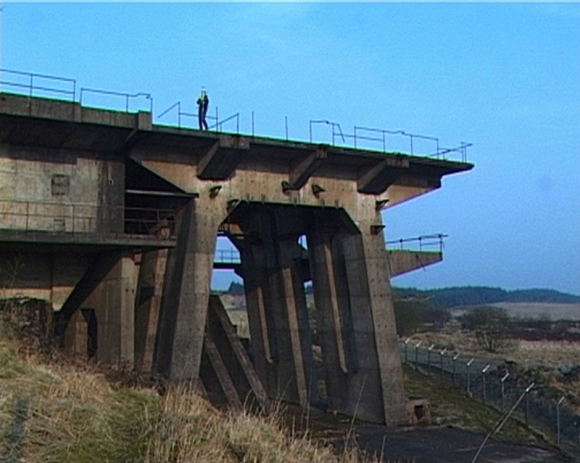
The remote location of Spadeadam in Cumbria has an extraordinary history of occupation: it was the rocket test site for the Cold War Intermediate Range Ballistic Missile Blue Streak in the late 1950s and 60s and is currently used by the RAF as an electronic warfare tactics range. Clunky life-size wooden models of Soviet army tanks, missile launchers and fake runways now combine with electronic signals to fool pilots of low-flying jets. Over three years following a residency at Grizedale Arts, I made repeat visits to Spadeadam producing a number of artworks including a film called, simply, Spadeadam (2003), which centred on my observation of an English Heritage archaeological survey of the Blue Streak rocket launch site. The chance to observe and document the archaeologists at work offered a useful opportunity to comment at a remove and attempt to provide an architectural and contextual perspective through the documenting of this process of mapping. The knowledge that these Cold War structures (with a complex history within living memory) were to be scheduled as Ancient Monuments, added a paradoxical captioning. Spadeadam was also about investigating space, taking visual ownership by flying over the RAF base on a weekend when the airspace was open for example and following the archaeologists at work - observing their strange performance with GPS equipment as they clambered over dips, slopes and disintegrating concrete. In the final sequence of the video, a lone bagpiper (ex-employee John Salton, an instrumentation engineer) is playing the lament Scots Wha' Hae. He marches slowly around the concrete surround of the control bunker in and out of a patch of late afternoon sunlight. A specially commissioned sound track was made by the band :zoviet*france: created in part from manipulated field recordings the two musicians made on-site: the edgy metallic scraping of gate locks repeatedly opened and shut, buttons on old fuse boxes rattled, a trout leaping for flies in a concrete water tank and the sampled bagpipe playing. (The English Heritage archaeologists had alerted us to some of the unusual acoustics they had encountered). Other sounds were created electronically, such as a low frequency rumble that might have been such a feature of the site when it was active. It was hoped this conveyed the surreal atmosphere when the working archaeologists were encircled both by invisible simulated electronic warfare and springtime birdsong, in the week after the second Gulf War started. I added voices on to the soundtrack including memories from those who had worked there in the 1950s and 60s (having attended two reunions of rocketmen, which is where I had heard the story of John Salton's bagpipe-playing, downwind of Wernher Von Braun) and extracts from telephone conversations with two RAF pilots who had flown over on training exercises and attempted to describe the landscape from memory. |